
Twin Fins Compared with Thruster Fins: Speed, Flow or Control?
Compare twin fins with thruster surfboard fins to find the best setup for speed, flow, control and everyday surfing.
Choosing between twin fins and thruster surfboard fins changes far more than the number of fins under your board. Twin fins generally feel faster, freer and more flowing, while thruster fins provide greater stability, tighter turning control and more predictable performance in powerful waves.
The right choice depends on your board, the waves you surf and whether you prefer effortless speed or precise control.
Quick Answer: Twin Fin or Thruster?
Choose twin fins if you want:
Fast, effortless acceleration
Less drag through weaker sections
Smooth, flowing turns
A loose and lively feeling
More freedom through the tail
Classic fish or modern twin-fin performance
Choose thruster fins if you want:
Greater control in powerful surf
Predictable hold through hard turns
Tighter direction changes
More stability under your back foot
Reliable performance across varied conditions
A familiar all-round surfing experience
The simplest comparison: twin fins favour speed and flow; thrusters favour control and predictability.
Explore the complete range of Eveley surfboard fins, including twin, thruster, quad and centre-fin options made in Australia.
What Is a Twin-Fin Setup?
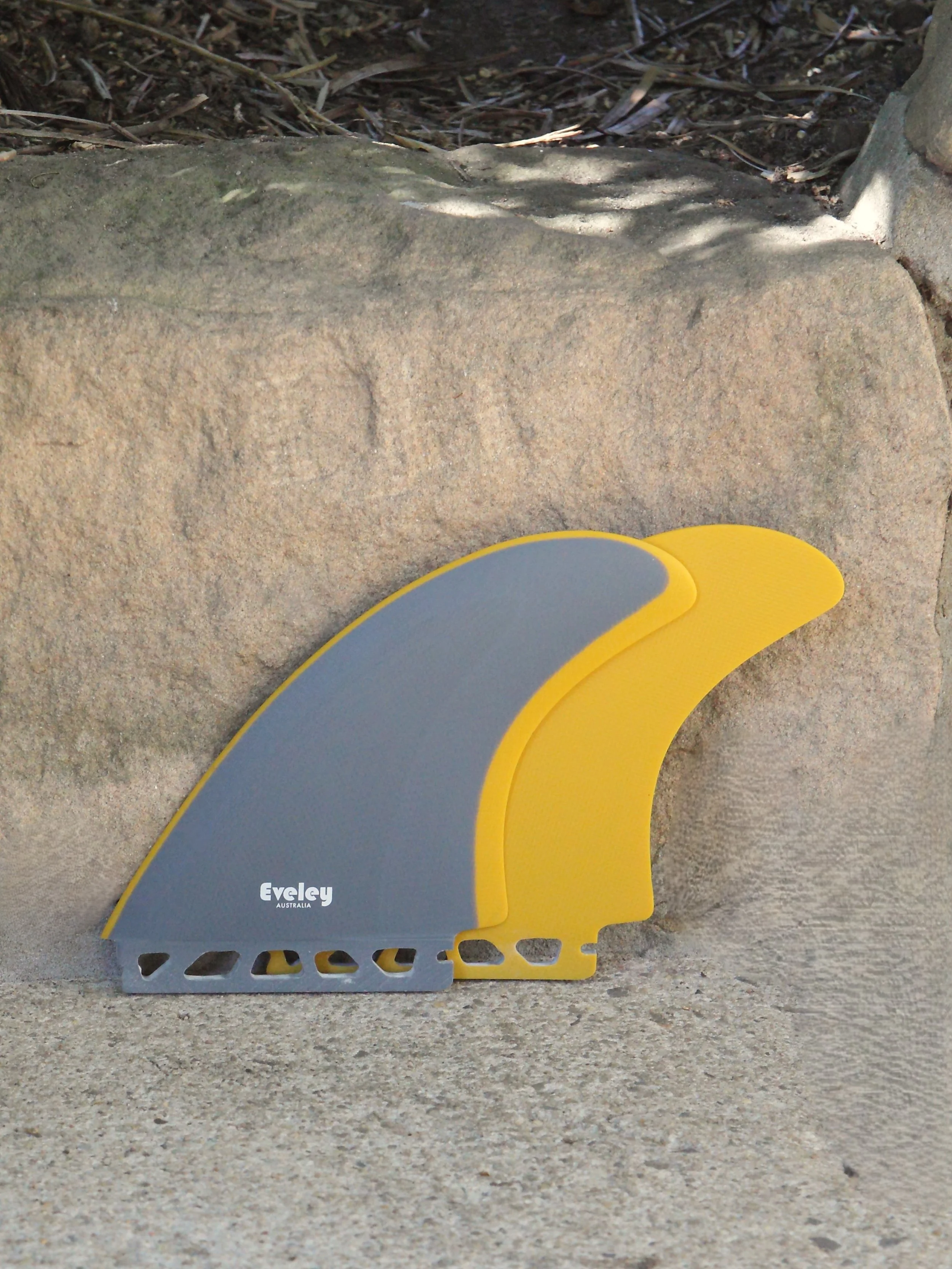
A twin-fin surfboard uses two relatively large side fins with no centre fin. Removing the centre fin reduces resistance through the water and allows the board to accelerate quickly.
Twin fins are commonly associated with fish surfboards, but modern upright templates have made them suitable for much more progressive surfing. Depending on the template, twin fins can provide anything from long, drawn-out fish-board lines to fast, vertical direction changes.
The two most common styles are:
Twin Keel Fins
Keel fins have a wide base, substantial surface area and a swept-back outline. They are designed to generate strong drive and maintain speed through long, flowing turns.
They are generally best suited to traditional fish boards and wider-tailed designs.
See the Twin Keel Surfboard Fins Guide for a closer look at keel-fin speed, hold and board compatibility.
Upright Twin Fins
Upright twin fins have less rake and a more vertical outline. They pivot more easily than traditional keels, making them suitable for tighter turns and modern twin-fin surfing.
They retain the speed and freedom of a twin while providing a more responsive feeling through direction changes.
Learn more in the Upright Twin Fins Performance and Setup Guide.
What Is a Thruster-Fin Setup?
A thruster uses three fins: two larger side fins and a centre fin.
The centre fin adds stability and gives the surfer a more dependable pivot point. This creates greater control when pushing hard through bottom turns, carving on rail or surfing steeper and more powerful waves.
Thrusters became the standard performance setup because they balance:
Speed
Drive
Hold
Turning control
Stability
Predictable release
Compared with twin fins, thrusters usually require slightly more effort to generate speed. The benefit is a more controlled and familiar response when the surfer applies pressure through the back foot.
For a deeper explanation, read the Thruster Surfboard Fins Guide.
Twin Fins vs Thruster Fins: Performance Comparison
Speed: Twin fins accelerate quickly and create speed naturally. Thruster fins usually require more pumping and turning to generate speed.
Drag: Twin fins have less drag because there is no centre fin. Thrusters create slightly more resistance because they use three fins.
Turning: Twin fins feel free, smooth and flowing through turns. Thrusters feel more direct and controlled, making tighter turns easier.
Hold: Twin fins rely more heavily on the surfer engaging the rail and using the fin area correctly. Thrusters provide strong, predictable hold from their three-fin arrangement.
Tail release: Twin fins release easily and feel lively underfoot. Thrusters provide a more controlled and deliberate release.
Stability: Twin fins feel looser beneath the back foot. Thrusters feel more stable and balanced.
Weak waves: Twin fins carry speed well through small, soft or flat sections. Thrusters may require more effort from the surfer to maintain speed.
Powerful waves: Twin fins remain fast but can feel loose at higher speeds. Thrusters provide more dependable hold and control.
Surfing style: Twin fins suit smooth, flowing lines and speed-focused surfing. Thrusters are better suited to precise, high-performance manoeuvres.
Ease of use: Twin fins require confident rail engagement and accurate foot pressure. Thrusters feel familiar and predictable for most surfers.
Why Do Twin Fins Feel Faster?
Twin fins often feel faster because they create less drag.
A thruster’s centre fin adds hold and stability, but it also adds another surface moving through the water. With no centre fin, water can flow more freely through and away from the tail of a twin-fin board.
This produces three noticeable differences.
Earlier Acceleration
Twin fins begin generating speed quickly, making them particularly effective in small or weak waves. They can carry momentum through sections where a thruster may need to be pumped.
Greater Down-the-Line Speed
Once moving, twin fins maintain speed with relatively little effort. Their larger side fins provide drive while the open centre of the tail reduces resistance.
More Freedom Through Turns
Without a centre fin anchoring the tail, a twin can release more easily at the end of a turn. This creates the fast, loose and lively sensation associated with twin-fin surfing.
For a broader explanation of twin-fin design, read Twin Surfboard Fins Explained.
Why Do Thruster Fins Offer More Control?
Thrusters distribute fin area across three fins. The centre fin helps stabilise the board and keeps the tail connected when the surfer applies pressure through a turn.
This gives thruster surfboard fins several advantages.
Predictable Hold
The three-fin cluster provides dependable grip during bottom turns, powerful carves and steep take-offs.
Tighter Direction Changes
A thruster responds directly to pressure from the back foot. This makes it easier to redirect the board sharply and surf more vertically.
Greater Stability
The centre fin reduces the loose tail movement commonly experienced on a twin. This can make a thruster feel more reassuring in bumpy water, powerful surf and late drops.
Wider Wave Range
A versatile thruster setup can perform in small beach breaks, clean point waves and more powerful surf. This broad operating range is why thrusters remain the standard choice for many surfers.
Which Setup Is Better in Small Waves?
Twin fins generally have the advantage in small or weak waves.
Their reduced drag and rapid acceleration help the board move through flat sections without constant pumping. A wide-tailed twin-fin board paired with an appropriate fin template can generate speed even when the wave offers little power.
Twin fins are a strong choice when you want:
Easy speed in soft waves
Better momentum across flat sections
Longer, flowing turns
A lively board without constant pumping
Thrusters can still perform well in small waves, particularly when paired with a lightweight board and appropriately sized fins. However, they usually depend more heavily on surfer input to generate and maintain speed.
The 5.5″ EN Twin Fins in grey and mustard Pro Glass are designed to combine twin-fin speed with strong drive and control.
Which Setup Is Better in Powerful Waves?
Thruster fins generally provide the more controlled option in steep, fast or powerful waves.
The centre fin adds stability when the board is moving at speed and helps prevent the tail from sliding unexpectedly. This allows the surfer to commit more confidently to hard bottom turns and critical direction changes.
A thruster is usually the better choice when you need:
Strong hold at higher speeds
Control on steep wave faces
Stability through late drops
Predictable performance in changing conditions
Confidence during powerful turns
Experienced twin-fin surfers can use larger or more drive-oriented twin fins in powerful surf, but the board must be surfed with clean rail engagement. A twin is less forgiving when too much pressure is placed directly over the tail.
For dependable all-round control, consider the 4.6″ Performer Thruster Fins in Pro Glass.
How Turning Differs Between Twin and Thruster Fins
The difference becomes most obvious when changing direction.
Turning with Twin Fins
Twin fins are driven primarily through the board’s rail and the two larger side fins. They favour smooth transitions, fast arcs and continuous forward movement.
To get the best from a twin:
Enter turns with speed
Engage the rail progressively
Avoid placing excessive pressure directly over the tail
Let the board travel through the turn
Use the open face of the wave to create flowing lines
Upright twin fins make tighter turns easier, while keel fins produce longer and more drawn-out arcs.
Turning with Thruster Fins
Thrusters allow the surfer to push more directly against the fin cluster. The centre fin provides a stable pivot point, making sharp changes of direction easier to control.
A thruster is better suited to:
Tight bottom turns
Vertical surfing
Hard back-foot pressure
Controlled top turns
Rapid rail-to-rail direction changes
The thruster feels more planted; the twin feels freer.
Twin Fin vs Thruster: Which Is More Forgiving?
For most surfers, a thruster is the more forgiving setup.
The centre fin helps correct small errors and provides extra stability when the surfer’s weight is not perfectly positioned. A thruster also behaves predictably across a broader range of wave conditions.
Twin fins can feel less forgiving because they respond strongly to changes in rail pressure and foot placement. If the surfer pushes too hard through the tail without engaging the rail, the fins may release.
However, twin fins can also make weak-wave surfing easier because they produce speed with less effort. The best choice depends on whether the surfer needs help generating speed or maintaining control.
Does Fin Material Change the Comparison?
Yes. Fin material affects flex, response, hold and the way energy is released through a turn.
Soft fins can feel forgiving, but excessive flex may reduce drive and control. Solid fibreglass fins generally provide a more positive response because they flex progressively and return energy cleanly.
Eveley twin and thruster surfboard fins are made from performance-focused materials, including solid Pro Glass fibreglass.
Pro Glass can provide:
Reliable hold under pressure
Controlled flex
Clean rebound through turns
Greater responsiveness than soft moulded fins
A solid, connected feeling beneath the board
Learn how construction affects performance in the Surfboard Fin Materials Guide.
Should You Choose Upright or Raked Fins?
Template shape matters within both fin setups.
Upright Templates
An upright fin has less sweep and pivots more easily. It suits surfers who want:
Tighter turns
Quick direction changes
A responsive feeling
More vertical surfing
The 5.7″ Upright Twin Fins in natural Pro Glass combine twin-fin speed with a more pivot-oriented outline.
Raked Templates
A raked fin sweeps further towards the tail. It produces longer turns and maintains hold through broader arcs.
Raked fins suit surfers looking for:
Strong drive
Longer carving turns
Hold at speed
Smooth directional changes
The choice between upright and raked templates can be just as important as choosing between twin and thruster setups.
Can You Add a Stabiliser to Twin Fins?
Some surfboards are designed for a twin-plus-stabiliser setup. This combines two large twin fins with a much smaller centre fin.
The stabiliser reduces some of the twin’s looseness and adds control without making the board feel exactly like a thruster. It can be useful for surfers who enjoy twin-fin speed but want extra stability in more powerful or uneven waves.
A stabiliser may provide:
More control through the tail
Improved stability at higher speeds
Greater confidence during hard turns
Less unexpected release
The compromise is slightly more drag and less tail freedom than a true twin-fin setup.
A twin-plus-stabiliser should only be used in a board designed with the correct centre-fin position. It is not a direct substitute for a matched thruster set.
Does Board Design Determine the Best Setup?
Yes. Surfboard fins must match the board’s shape, fin-box configuration and intended performance.
Twin-fin boards commonly have:
Wider tails
Fuller outlines
Increased planing area
Fin boxes positioned specifically for larger twin fins
Bottom contours designed to generate speed and rail engagement
Thruster boards commonly have:
Narrower or more refined tails
A balanced three-fin cluster
More conventional performance outlines
Designs intended for back-foot control
Greater emphasis on tight direction changes
Do not choose a fin setup based solely on the performance description. The board must have the correct boxes and be designed to work with that configuration.
If you are unsure about fin systems and fit, consult the FCS vs FCS II Surfboard Fin Compatibility Guide.
Important: FCS II fins do not fit FCS dual-tab fin systems. Always match the fins to the fin boxes installed in your board.
Who Should Choose Twin Fins?
Twin fins are ideal for surfers who:
Value speed and flow
Regularly surf small or medium-sized waves
Ride fish boards, performance twins or suitable hybrids
Prefer open-face surfing and smooth lines
Want less resistance and easier acceleration
Are comfortable using the board’s rail
Enjoy a loose and lively tail
For classic fish-board drive, the 4.5″ Twin Keel Fins in black Pro Glass offer a broad keel template designed for speed, hold and flowing turns.
Who Should Choose Thruster Fins?
Thruster fins are ideal for surfers who:
Want dependable all-round performance
Surf varied or changing conditions
Prefer tight and controlled turns
Apply strong pressure through the back foot
Need additional hold in powerful waves
Ride conventional performance shortboards
Want a familiar and predictable setup
The 4.5″ Responder Thruster Fins in Pro Glass are designed for speed, quick pivot, controlled turns and clean release.
Twin Fins vs Thruster Fins: Final Choice Guide
Choose twin fins when your priority is:
Natural speed
Low drag
Flowing turns
Easy acceleration
Tail freedom
A lively surfing experience
Choose thruster fins when your priority is:
Control
Stability
Tight turns
Hold in powerful waves
Predictable release
Versatility across conditions
If you mainly surf weak beach breaks or enjoy fast, flowing lines, a twin will often feel more exciting. If you surf a wide range of waves and want dependable control, a thruster is usually the safer all-round choice.
Frequently Asked Questions
Are twin fins faster than thruster fins?
Twin fins usually feel faster because they have no centre fin and therefore create less drag. They accelerate quickly and carry speed effectively through weak or flat sections.
Are thruster fins easier to surf?
Thrusters are generally easier for surfers accustomed to conventional shortboards. Their centre fin adds stability, hold and a predictable pivot point.
Are twin fins good for beginners?
Twin fins can generate speed easily, but their loose tail and rail-driven turning style may be less predictable for a beginner. A thruster usually provides greater stability while learning.
Can I put twin fins in a thruster board?
Installing only the two side fins in a thruster board does not normally create a properly balanced twin-fin setup. Twin-fin boxes are positioned differently, and true twin fins are generally larger than thruster side fins.
Can I use thruster side fins as twin fins?
Thruster side fins are generally too small to provide the necessary drive and hold when used without the centre fin. A matched twin-fin set is the better choice.
Are twin fins suitable for large waves?
They can be used in powerful surf by experienced surfers, particularly when the board and fins are designed for those conditions. A thruster generally provides more dependable hold and control.
What is the difference between twin fins and keel fins?
A twin fin describes the two-fin setup. A keel is a particular twin-fin template with a wide base, substantial area and considerable rake. Upright performance twins are narrower and pivot more readily.
Should I use a twin plus stabiliser?
A stabiliser is useful when you want more control than a true twin without moving to the fully planted feeling of a thruster. The board must have the correct centre-fin box and placement.
Explore the Eveley Surfboard Fin Knowledge Hub
Continue with these Eveley guides:
The Bottom Line
The choice between twin and thruster surfboard fins comes down to the feeling you want from your board.
Twin fins produce rapid acceleration, reduced drag and a fast, flowing ride. Thruster fins add centre-fin stability, tighter turning control and dependable hold across a wider range of conditions.
Neither setup is universally better. The best surfboard fins are the ones that suit your board, your waves and the way you want to surf.
Explore Eveley surfboard fins and compare twin, thruster, quad and centre-fin options for your next setup.