
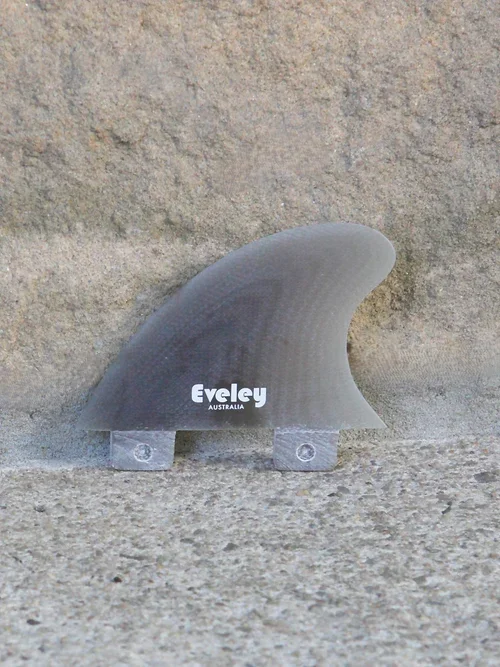
Choose stabilizer surfboard fins for the control your setup needs. Compare nubsters and Classic trailers from Eveley Fins, check compatibility and find the balance between hold and freedom.
Stabilizer surfboard fins from Eveley Fins give surfers a way to adjust how readily the tail holds or releases. If your twin setup feels enjoyable until you push into a turn, a small centre trailer may provide the extra support you want.
The right choice depends on the whole board and fin combination. More fin can add hold, but it also changes resistance and turning response. Start with a clear goal: a subtle adjustment, or a more noticeable increase in control.
Should You Add a Stabilizer Fin?
Consider a stabiliser when your board has a suitable centre fitting and the tail releases more readily than you want. A low-profile nubster offers a smaller adjustment; a larger Classic trailer is worth comparing when you want a more substantial centre-fin contribution.
If the board already feels stiff or reluctant to turn, adding more fin may move it further from the feel you want.
Compare Eveley stabilizer fins by size and fitting.
What Is a Stabilizer Fin?
A stabiliser, also written “stabilizer”, is a centre fin used to support the main fins. In a twin-plus-trailer setup, the two larger side fins remain the dominant pair and the smaller rear fin supplements their hold.
“Trailer” describes that supporting role. “Nubster” usually describes a particularly shallow, low-profile centre fin. Larger stabilisers use more conventional fin outlines.
These terms do not specify compatibility. A fin still needs the correct base for the centre fitting in your board.
How Stabilizer Surfboard Fins Change Performance
More resistance to unwanted tail slide
A rear fin contributes resistance to sideways movement. In a suitable setup, this can make the tail feel more settled when loading a turn.
A different balance between hold and release
Extra support can make a loose setup easier to manage. It can also make deliberate release harder. The useful question is whether the change helps you complete the turns you want.
Speed depends on the result, not just the fin count
An additional fin adds wetted surface and changes the forces acting on the board. It does not guarantee a speed increase or a drag-free improvement. Better control may help you maintain a useful line; too much fin may make the board feel restricted.
Compare several similar waves before deciding whether the change is beneficial.
Compare Eveley Fins: Nubsters and Classic Stabilisers
These products illustrate different depths and fitting systems. They are not a universal progression that every surfer should work through.
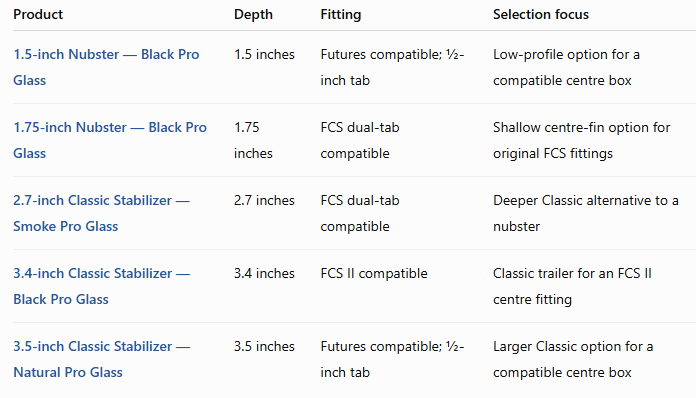
Compare base length and outline as well as depth. For example, the 2.7-inch Classic has a 4-inch base, while the 3.5-inch Classic has a 3.5-inch base. Height alone cannot describe their complete performance difference.
Twin, Twin Plus Trailer or Quad Plus Nubster?
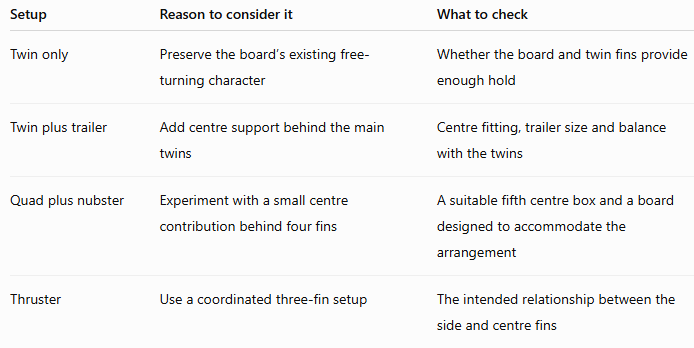
A twin-plus-trailer arrangement does not become a conventional thruster simply because both use three fins. Fin sizes, templates and placement determine the balance.
Explore the broader comparison in Twin Fin vs Thruster — Speed vs Control.
Nubster or Classic Template?
A nubster is a useful starting point when you want to test a small centre-fin contribution. A Classic trailer provides a deeper outline to compare when a shallow option does not deliver the support required.
Avoid choosing solely from a label such as “small”, “medium” or “maximum control”. Compare the actual fin, the board maker’s guidance and the size of the main fins. Rider weight alone is not enough to select a trailer.
For the low-profile end of the range, read How Nubster Fins Change Performance.
Why Pro Glass Construction Matters
The featured Eveley Fins models use Pro Glass fibreglass. Construction influences how the fin responds under load, alongside its thickness, foil and outline.
A small fin can still have a firm flex. Likewise, two fibreglass fins need not flex identically simply because they share a material description.
Read What Is Pro Glass? for more on the construction used in these surfboard fins.
Check Compatibility Before Choosing Size
FCS dual-tab: Match the fin to the appropriate original FCS centre fitting.
FCS II: Choose the correct FCS II-compatible model. FCS II fins do not fit FCS dual-tab systems.
Futures compatible: Check the centre-box depth as well as the system name. The featured Futures-compatible models have ½-inch tabs.
Sliding center fin box: Choose a fin specifically made for that fitting; the shortboard-system fins above are not direct substitutes.
Use the Surfboard Fin Compatibility Guide to identify your system before ordering.
Can the stabiliser move forward or back?
Standard FCS and Futures installations have a fixed location. Do not try to reposition a fin by leaving it partly seated. Fore-and-aft tuning applies only where the actual fitting provides adjustment, such as a suitable sliding center fin box.
Which Boards and Conditions Suit a Stabiliser?
A compatible twin-plus-trailer hybrid or fish provides a practical setting for testing a trailer. A dedicated twin with no centre fitting cannot accept one as a simple fin swap.
For everyday surf, assess the moment that causes difficulty: does the tail release during a loaded turn, or does the board already resist changing direction? That observation is more useful than assuming every board needs extra hold once the waves reach a particular height.
Mid-lengths also vary. A small stabiliser supporting substantial side fins serves a different role from the main centre fin in a conventional longboard 2+1 arrangement. Follow the intended configuration of the board.
Common Stabiliser Mistakes
Buying before checking the centre fitting. Confirm the system and required tab depth first.
Choosing by height alone. Include base length, outline and the main fins in the comparison.
Expecting extra fin to guarantee extra speed. Judge hold, turning effort and flow together.
Changing all the fins at once. Keep the main pair unchanged when testing a trailer.
Treating a tiny trailer as a longboard single fin. Its supporting role requires an appropriate complete setup.
Stabilizer Fin FAQs
Is a stabilizer fin the same as a trailer fin?
In a twin-plus-trailer setup, the terms commonly describe the small supporting centre fin behind the twins. Check the product’s dimensions and fitting rather than relying on the name alone.
Will a stabiliser stop the tail sliding?
It may reduce unwanted release in a suitable setup. It cannot guarantee grip in every turn; technique, board design, conditions and the other fins remain important.
Should the smallest available stabiliser always be chosen first?
No. Use the board maker’s recommended setup as the starting point. A shallow nubster is an option for a subtle experiment, but it may not provide the support a particular board requires.
Can a nubster be added to a quad?
Yes, where the board has a suitable fifth centre box and accommodates that arrangement. Compare the result against the existing quad setup rather than assuming five fins will perform better.
Does removing a thruster centre fin create a proper twin setup?
Not necessarily. Thruster side fins and their placement may differ from the twin fins the board needs. Select the complete configuration around the board’s design.
Which Eveley Fins stabiliser fits original FCS plugs?
The featured 1.75-inch Nubster and 2.7-inch Classic are FCS dual-tab-compatible options. The 3.4-inch Classic shown above is FCS II compatible and does not fit original FCS dual-tab plugs.
Eveley Surfboard Fin Knowledge Hub
Continue choosing your surfboard fins with these guides:
Surfboard Fins Australia — Complete Buyer’s Guide: compare the broader setup options.
Surfboard Fin Compatibility Explained: identify the fitting your board requires.
Twin Fin vs Thruster — Speed vs Control: understand the main setup trade-offs.
What Is Pro Glass?: explore fibreglass construction.
Choose the Control Your Board Needs
Start with the fitting, then decide how much centre-fin support the setup needs. Compare a low-profile nubster with a deeper Classic trailer, and test one change at a time.
Explore the Eveley Fins stabilizer range to compare compatible options. For original FCS fittings, the 2.7-inch Classic in Smoke Pro Glass is a deeper alternative to the featured nubster.
Futures™ is a registered trademark of Futures Fins. Eveley Surf is not affiliated with or endorsed by Futures Fins. All compatibility references to Futures Fins are for descriptive purposes only.
FCS™ and FCS II™ are registered trademarks of Surf Hardware International Pty Ltd. Eveley Surf is not affiliated with or endorsed by Surf Hardware International Pty Ltd. All compatibility references to FCS and FCS II are for descriptive purposes only.