
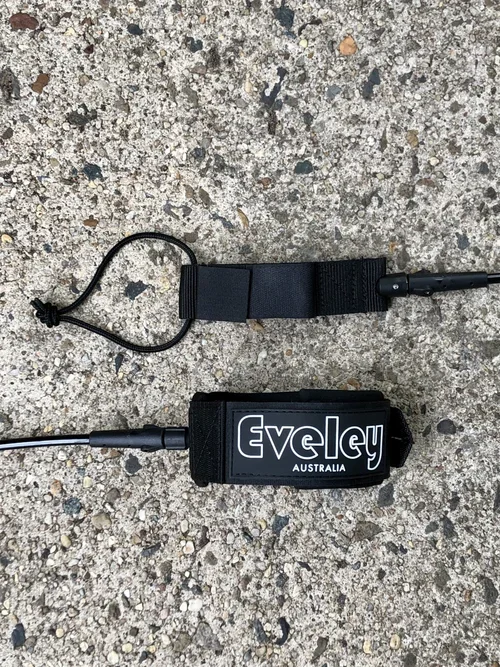
Choose your surfboard leash at Eveley Surf. Compare leash lengths, 7 mm cords and ankle versus calf cuffs for shortboards, longboards and logs.
A surfboard leash connects you to your board, and this Eveley Surf guide explains how to choose the right length, cuff and construction for your setup. Known in Australia as a leg rope, a leash should suit both the board you ride and the conditions you enter.
Start with board length, then consider wave power, board size and how you move on the deck. A shortboard surfer and a longboarder who cross-steps have different priorities, even when both surf the same beach.
Quick Answer: Which Surfboard Leash Should You Choose?
Choose a leash approximately the same length as your board or slightly longer as a practical starting point, then check the product’s intended use. Match the cuff to your surfing style and the leash construction to the conditions.
Shortboards and fish around 6 feet or shorter: consider the Eveley Surf 6′ ankle leash.
Longboards around 8′6″–9′6″: consider the Eveley Surf 9′6″ longboard ankle leash.
Logs and longboards around 9–10 feet, with cross-stepping in mind: consider the Eveley Surf 10′ Loggers calf/knee leash.
For boards between these sizes, choose the appropriate intermediate length rather than forcing a match to the options above. For boards longer than 10 feet, assess a longer leash. Length alone does not establish suitability for powerful surf.
What Does a Surfboard Leash Do?
A leash helps keep your surfboard within reach after a wipeout and reduces the chance of a completely loose board travelling through the lineup. It cannot prevent every collision, breakage or separation.
A typical surf leash has five main parts:
Urethane cord: The flexible cord that connects you to your surfboard.
Cuff: The padded strap that fastens around your ankle or calf.
Swivels: Rotating joints that help stop the leash from twisting and tangling.
Rail saver: A wide webbing strap that helps protect the board’s tail edge from damage caused by the leash pulling against it.
Leash string: A short loop of strong cord that connects the rail saver to the board’s leash attachment point.
The complete assembly matters. A sound cord cannot compensate for a frayed string, damaged attachment or cuff that no longer closes securely.
How to Choose Surfboard Leash Length
Board length is the simplest starting point. Too little length restricts separation after a fall; unnecessary extra length leaves more cord to trail and manage.
Boards from 5′6″ to 6′0″: A 6′ leash is a practical starting point. Check that the cord suits the intended surf conditions and the cuff fits securely.
Boards from 6′6″ to 8′0″: Choose a 7′ or 8′ leash, or a longer option if needed. Match the leash to the actual board length and follow the manufacturer’s guidance.
Boards from 8′6″ to 9′6″: A 9′6″ leash is a practical starting point. Check the board’s length and choose an ankle or calf cuff to suit your preference.
Traditional longboards from 9′0″ to 10′0″: A 10′ leash is a practical starting point. Consider walking along the board, cuff comfort and the intended surf conditions.
Boards longer than 10′: Choose a longer leash suited to the board. Follow the manufacturer’s guidance for its size and intended use.
These are starting points, not wave ratings. A large, buoyant board can place substantial loads on a leash when caught by whitewater, even in surf that does not look especially big.
Do not choose a shorter leash solely to reduce drag. Begin with a suitable length and construction, then compare comfort and handling.
Ankle vs Calf Leash: Which Cuff Suits Your Surfing?
Ankle cuffs for a familiar setup
An ankle cuff is the usual starting point for shortboards and is also a practical option for longboards. It sits low on the rear leg and suits surfers who prefer a familiar attachment position.
The 9′6″ longboard ankle leash is an option for longboarders who want an ankle attachment rather than a dedicated calf cuff.
Calf cuffs for longboard footwork
A calf cuff, often called a knee cuff, attaches higher on the lower leg. This changes where the cord leaves the body and can help keep it away from your feet while walking the board. It does not eliminate tangles or guarantee an unobstructed deck.
The 10′ Loggers leash is the Eveley Surf option to compare when cross-stepping and noseriding are central to your surfing.
Ankle cuff: Fastens around your ankle and is a familiar choice for shortboarding and general longboarding. The cord can get in the way when walking along a longboard.
Calf/knee cuff: Fastens higher on your leg, just below the knee, to help keep the cord clear of your feet when walking along a longboard. It needs to fit securely and will not prevent every tangle.
A cuff change affects cord management. The board and fin setup determine much of the stability available while walking the deck. Explore the Eveley Surf Longboard Fin Setup Guide when choosing between single-fin and 2+1 arrangements.
Leash Thickness: What Does a 7 mm Cord Tell You?
Cord diameter is one part of leash selection. Within otherwise comparable designs, a thicker cord generally trades more water resistance for greater material cross-section. Construction, connection design, wear and intended use also affect reliability.
The three Eveley Surf leashes featured here are listed with 7 mm urethane cords and stainless steel swivels. They offer different lengths and cuff positions within the everyday surfing range.
A 7 mm measurement is not a universal strength guarantee or big-wave rating. For powerful or specialist conditions, choose equipment expressly suited to that use. Do not infer a breaking load or maximum wave height from diameter alone.
Compare Eveley Surf Leashes
6′ Surfboard Leash — Black: A 6-foot leash with a padded ankle cuff and a 7 mm urethane cord. Suits shortboards and fish boards of an appropriate length.
9′6″ Longboard Leash — Black: A 9-foot 6-inch leash with a padded ankle cuff and a 7 mm urethane cord. An option for longboarders who prefer the leash attached at the ankle.
10′ Loggers Leash — Black: A 10-foot leash with a calf/knee cuff and a 7 mm urethane cord. The higher cuff position helps keep the cord clear of your feet when walking or cross-stepping along a longboard.
Choose by board length first, cuff preference second, then confirm suitability for the conditions. Colour and styling come after fit and function.
How to Fit a Surfboard Leash
Inspect the board attachment. Check the leash plug or other attachment for damage and confirm the string is sound.
Keep the string clear of the rail. Use a suitable short loop so the rail saver, rather than bare string, bears against the tail edge.
Secure the rail saver. Follow the leash’s fastening arrangement and fully engage each closure.
Fit the cuff on the rear leg. Use the ankle or calf position the cuff is designed for. Fasten it snugly without restricting circulation.
Check the release and cord. Keep the release tab accessible, remove twists and confirm the cord is clear of your feet and fins.
Avoid wrapping the cord around your hand or fingers when retrieving the board. Keep space from other surfers: the board can still travel through a considerable arc while attached.
Leash Care and When to Replace It
Rinse the leash with fresh water after surfing, remove sand from the closures and allow it to dry in the shade. Store it loosely in a cool place rather than tightly wrapped around the board and fins.
Before each session, check for:
Cuts, nicks, cracks or damaged areas in the cord.
Fraying around the string, rail saver or stitching.
Loose connections or swivels that no longer rotate properly.
A cuff closure that will not hold securely.
Unusual permanent stretching or deformation after a heavy load.
Replace damaged components or the complete leash as appropriate before returning to the water. There is no single replacement interval that suits every surfer: use, exposure and loading vary.
Common Surfboard Leash Mistakes
Using one length for every board. A 6′ leash is not a general substitute for a longboard leash.
Choosing only by cord thickness. The cuff, connections, string and intended use also matter.
Leaving the leash string too long. Bare string can contact and damage the tail edge.
Expecting swivels to prevent all tangles. Check cord position before paddling out and after a fall.
Treating a leash as a rescue device. A leash can fail. Surf within your swimming ability and the conditions you can manage.
Surfboard Leash FAQs
Is a leg rope the same as a surfboard leash?
Yes. In Australian surfing, “leg rope” and “surfboard leash” generally refer to the same equipment connecting the surfer to the board.
Should a surfboard leash be longer than the board?
Approximately the same length or slightly longer is a useful starting point. Check the leash manufacturer’s guidance and account for the board and conditions rather than treating length as the only requirement.
Is an ankle or calf leash better for longboarding?
An ankle leash suits surfers who prefer a low, familiar attachment. A calf leash is worth considering for cross-stepping because it raises the attachment point away from the feet. Choose a cuff designed for the position where it will be worn.
Can a 6′ leash be used on a 9′ longboard?
That is not a suitable default pairing. Choose a leash around the longboard’s length or slightly longer, with construction appropriate to its use.
Does a thicker leash guarantee it will not snap?
No. Cord diameter alone cannot establish reliability. Cuts, wear, connection quality and the load applied during a wipeout all matter.
Which Eveley Surf leash suits cross-stepping?
The 10′ Loggers leash has a calf/knee cuff and is the featured option for surfers seeking a higher attachment while walking the board. Confirm the length suits your longboard and the cuff fits securely.
Eveley Surfboard Fin Knowledge Hub
Complete the board setup with these related Eveley Surf guides:
Longboard Fin Setup Guide — Single, 2+1 and Performance Options: compare fin configurations alongside your longboard leash choice.
Surfboard Fins Australia — Complete Buyer’s Guide: explore sizing, setup, materials and compatibility across the Eveley Surf range.
Choose the Leash That Fits Your Board
The right surfboard leash starts with suitable length, a comfortable cuff and construction matched to the intended conditions. Good fitting and regular inspection are just as important as the initial purchase.
Compare the Eveley Surf 6′ ankle leash, 9′6″ longboard ankle leash and 10′ Loggers calf/knee leash to select the length and cuff arrangement that suit your board.
Quick Summary
A surfboard leash, or leg rope, connects the surfer to the board.
Start with a length approximately equal to the board or slightly longer, then check intended use.
Ankle cuffs suit familiar everyday setups; calf cuffs offer a higher attachment for longboard footwork.
Eveley Surf’s featured 6′, 9′6″ and 10′ leashes are listed with 7 mm urethane cords.
Inspect the entire assembly regularly. A leash is not a substitute for swimming ability or board control.