Quad Fin Setup and Performance Explained
The Real Reason Quads Feel Faster (And When They Don’t)
New to surfboard fins? Start with the complete Surfboard Fin Guides overview.
If you’ve ever felt a board suddenly come alive down the line, hold a rail at high speed, or accelerate without pumping — chances are you were riding a quad setup.
But quad performance isn’t magic.
It’s geometry.
And the biggest factor most surfers misunderstand?
Fin placement.
This guide breaks down exactly how quad fins work, how placement changes speed and control, and how to tune your setup for Australian conditions.
Quick Answer: What Does Quad Fin Placement Actually Change?
Quad fin placement directly affects:
Down-the-line speed
Rail hold at high velocity
Pivot vs drive balance
Release timing
Tail sensitivity
How the board feels in hollow vs open-face waves
Move the rears back → more hold + drive
Move them forward → more release + pivot
It’s that simple.
And that important.
How Quad Fins Work (Compared to Thrusters)
A quad removes the center fin and replaces it with two rear fins.
This creates:
• Less drag (no center fin turbulence)
• Cleaner water flow off the tail
• More rail-to-rail acceleration
• Stronger hold on the engaged rail
Without the center fin acting as a brake, water exits straighter and faster.
That’s why quads feel quicker.
But that speed depends entirely on where those rear fins sit.
The 4 Critical Quad Placement Variables
1. Front Fin Placement (Lead Fins)
These control:
Initial drive
Entry into turns
Rail engagement
More forward → looser feel
Further back → stronger drive off bottom turns
Most modern shortboards place fronts between 10.75"–11.5" from tail.
2. Rear Fin Distance From Tail
This is the most misunderstood variable.
Rear fins placed:
• Further back (closer to tail)
Maximum hold
Stronger projection
Better in hollow waves
• Further forward
Looser feel
Faster direction changes
More skatey
For powerful Australian beach breaks, slightly further back rear placement improves control in punchy surf.
3. Rear Fin “Spread” (Distance From Front Fins)
The closer the rears sit to the fronts:
More pivot
More thruster-like feel
The further apart they are:
More drive
More drawn-out arcs
Greater hold at speed
Wide spread = high-line speed machine
Tighter cluster = performance feel
4. Toe-In and Cant
These subtle angles change everything.
More toe-in:
Tighter turning radius
More responsiveness
Slightly more drag
Less toe-in:
Straighter projection
Maximum speed
Cleaner down-the-line flow
High-performance quads often use:
Slightly less toe on rear fins
Slightly less cant on rears than fronts
This keeps speed high while maintaining control.
Why Quads Feel Faster
Three reasons:
1. No Center Fin Drag
The middle fin on a thruster disrupts clean water exit. Removing it reduces turbulence.
2. Rail-Based Drive
Quads generate speed from the rail engaged fins — not the tail pivot.
3. Straighter Water Exit
Water flows between the fins and off the tail faster.
Less resistance = more speed.
When Quad Placement Goes Wrong
A quad can feel:
• Tracky
• Stiff
• Hard to pivot
• Or unpredictable
Usually because:
Rear fins too far back (too much hold)
Rear fins too large
Too much toe
Too much cant
Placement errors are often blamed on the fin template — when geometry is the real issue.
Quad Setups for Different Board Types
Shortboards (Performance)
Balanced front template
Smaller rears
Moderate spread
Slightly reduced rear cant
Goal: Speed without losing vertical attack capability.
Fish & Twin-Plus-Quad Hybrids
Larger fronts
Small, upright rears
Wider rear spread
Goal: Maximum drive with release on demand.
Step-Ups & Hollow Waves
Rears slightly further back
Reduced toe
Stronger hold profile
Goal: Rail control at high velocity.
Quad vs Thruster Placement Philosophy
A thruster uses the centre fin to control how the board pivots. That middle fin acts like a steering point, making turns feel predictable and controlled. This is why thrusters are generally better for tight, vertical surfing in the pocket.
A quad doesn’t have a centre fin. Instead, the two fins near the rails create drive and speed. Because there’s less drag through the middle of the tail, quads accelerate faster down the line and feel quicker on open faces. The trade-off is that they pivot differently — they rely more on rail engagement than a central turning point.
In simple terms:
Thruster = tighter, more predictable vertical turns. Thrusters suit tight pocket surfing.
Quad = more speed and faster rail-to-rail acceleration. Quads reward clean lines and projection.
How to Tune Your Quad Without Moving Boxes
You can simulate placement adjustments by:
• Increasing rear fin size → more hold (like moving back)
• Decreasing rear size → more release (like moving forward)
• Upright rear template → pivot feel
• Raked rear template → drive feel
Template + size effectively mimic placement shifts.
Designed for Australian Conditions
Beach breaks here demand:
Speed between sections
Rail hold in punchy walls
Control in shifting peaks
Quads excel when tuned correctly.
The wrong setup feels stiff.
The right setup feels unstoppable.
Common Myths About Quad Placement
Myth 1: Quads don’t turn vertically
→ Incorrect. Placement + rear sizing determines vertical capability.
Myth 2: All quads are faster than thrusters
→ Only when rear placement is optimised.
Myth 3: Bigger rear fins always mean more control
→ Too big kills responsiveness.
FAQs: Quad Fin Placement
Are quad rears supposed to be smaller?
Usually yes — they fine-tune hold without overpowering the front drive fins.
Can I run equal-sized quads?
Yes, but expect more hold and less pivot.
Do quads work in small waves?
Absolutely — especially on wider-tailed boards.
Why does my quad feel stiff?
Likely rear fins too large or too far back.
Final Takeaway
Quad performance isn’t just about “four fins.”
It’s about:
Rear distance from tail
Spread from front fins
Toe-in
Cant
Template pairing
Get placement right and a quad becomes:
Fast. Controlled. Predictable. Explosive.
Get it wrong and it feels like a different board.
Eveley Knowledge Hub Guides
Controller Split Keel Quad Fins Guide
Popular Quad Fin Setups
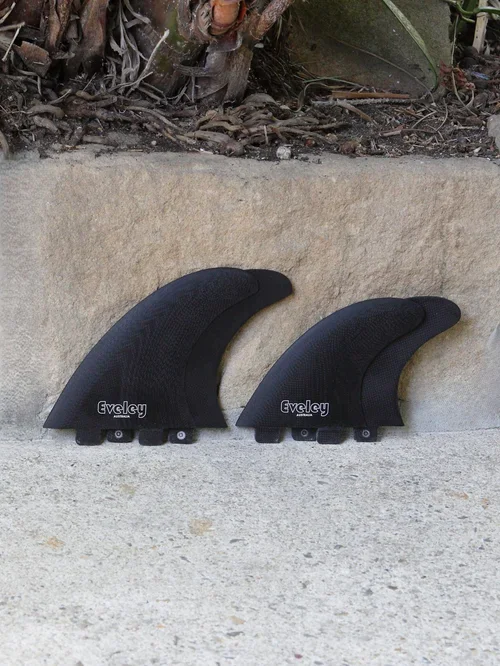
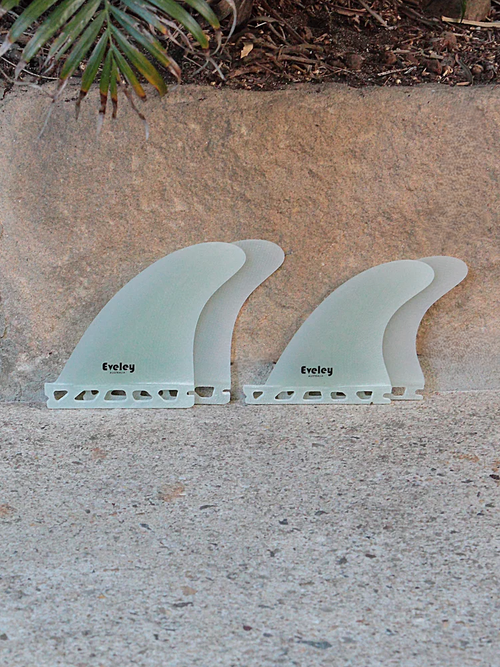
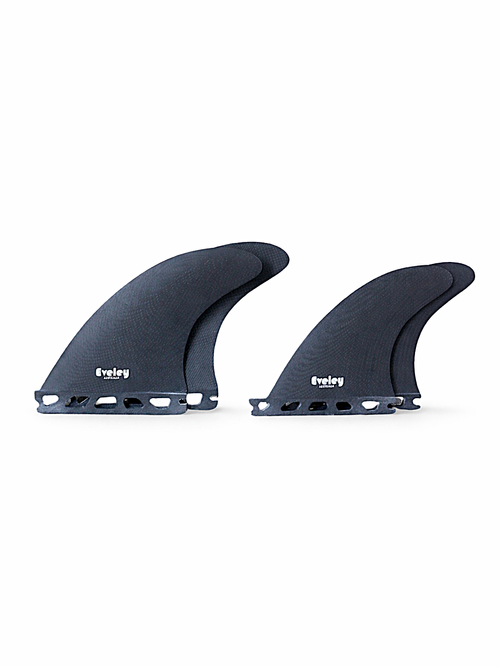
4.3" / 3.8" Freedom Quad Fins – Natural Pro Glass | Futures Compatible
4.5" / 4" F6 Quad Fins – Natural Pro Glass Futures Compatible
4.6" / 4.2" Classic Quad Surfboard Fins – Black Pro Glass Futures Compatible
Popular Quad Fin Rears
1.9" Mini Side Fins (Mini Quad Rears) – Black Pro Glass. FCS Compatible, Set of 2
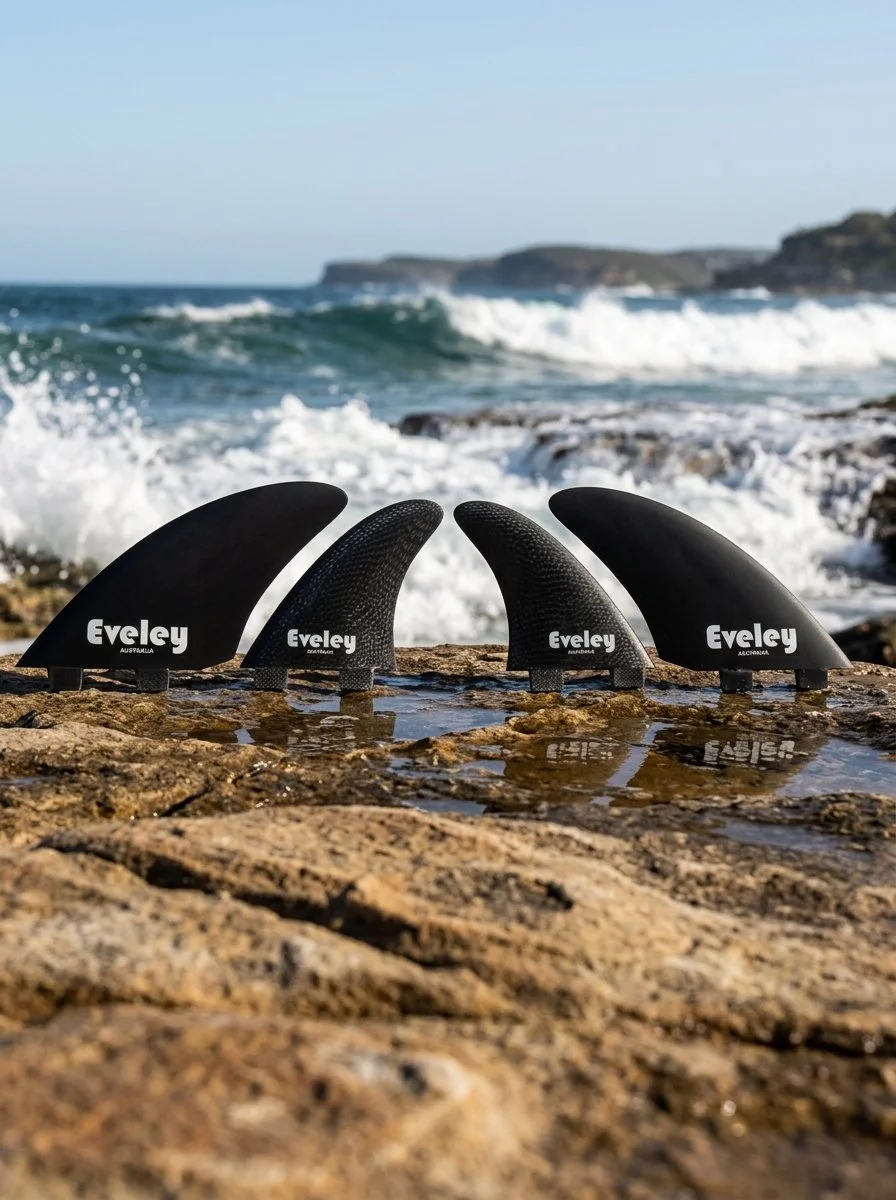
Eveley Quad Fins
Futures™ is a registered trademark of Futures Fins. Eveley Surf is not affiliated with or endorsed by Futures Fins. All compatibility references to Futures Fins are for descriptive purposes only.
FCS™ and FCS II™ are registered trademarks of Surf Hardware International Pty Ltd. Eveley Surf is not affiliated with or endorsed by Surf Hardware International Pty Ltd. All compatibility references to FCS and FCS II are for descriptive purposes only.