
Thruster Fin Size Guide

How to Choose the Right Thruster Fin Size for Power, Speed & Control

If you get thruster fin size wrong, your board will never feel right — no matter how good the shape is.

Too small? It feels skatey and unpredictable.
Too large? It feels stiff, slow and hard to turn.

This is the complete thruster fin size guide for Australian surfers who want their board dialled properly — whether you're riding shortboards, step-ups, grovellers or hybrids.

What Is a Thruster Setup?

4

A thruster is a three-fin configuration:

  • Two side fins (left & right)

  • One centre fin

Invented by Simon Anderson in 1980, the thruster became the most balanced, predictable and performance-driven fin system in surfing.

It delivers:

  • Control in powerful waves

  • Reliable rail-to-rail transitions

  • Hold under pressure

  • Predictable release

But none of that works properly if the fin size doesn’t match the surfer.

The Golden Rule of Thruster Fin Size

Fin size is matched to surfer weight first, board second.

That’s the rule most surfers ignore.

Your board size matters — but your body weight determines how much surface area you need to push against water.

Thruster Fin Size Chart (By Surfer Weight)

If you weigh under 55kg, you’ll generally suit an Extra Small (XS) thruster set. These fins are usually around 4.3 inches tall.

  • If you’re between 55–65kg, go with a Small (S) set. These are typically about 4.4 to 4.5 inches tall.

  • If you weigh 65–75kg, a Medium (M) thruster is the standard choice. Expect fins around 4.6 to 4.75 inches tall.

  • If you’re 75–90kg, you’ll usually need a Large (L) set. These are generally 4.8 to 5.0 inches tall.

  • If you’re over 90kg, look at Extra Large (XL) thrusters, which are typically 5.0 inches or bigger.
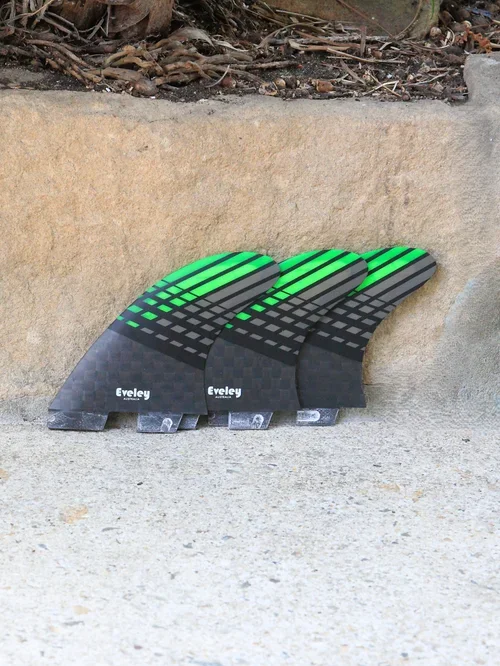
In short:
Your body weight determines the fin size first. The inch measurement refers to the height of the side fins, which directly affects hold and control.

This applies whether you're using:

  • FCS style dual tab

  • Futures single tab

  • Glass-on thrusters

Why Weight Determines Fin Size

Fins create resistance against water flow.

Heavier surfers:

  • Generate more force

  • Need more surface area

  • Require larger fins to prevent sliding

Lighter surfers:

  • Can overpower large fins

  • Need smaller templates to stay loose

Fin area = grip.
Fin size = leverage.

What Happens If Your Thruster Fins Are Too Small?

You’ll notice:

  • Tail slides unexpectedly

  • Loss of hold on bottom turns

  • Inconsistent drive

  • Instability in larger surf

This often happens when:

  • Surfers copy pro setups

  • Lightweight fins are used in solid surf

  • Groveller fins are used in punchy waves

What Happens If Your Thruster Fins Are Too Large?

You’ll feel:

  • Sluggish rail transitions

  • Harder top turns

  • Reduced release

  • “Stuck” feeling in small waves

This is common when:

  • Bigger wave fins are used in weak surf

  • Surfers oversize for “extra hold”

  • Boards are already wide through the tail

Board Type Adjustments

Weight gives you your base size.
Board type fine-tunes it.

High-Performance Shortboards

Stick to weight chart exactly.

Grovellers / Wide Tails

Consider dropping half a size smaller for looseness.

Step-Ups / Solid Waves

Consider going half a size larger for hold.

Hybrids

Match weight first. Adjust only if necessary.

Thruster Centre Fin Size — Should It Match?

Most thruster sets have a slightly smaller centre fin (approx 3–8% smaller area).

Why?

  • Reduces drag

  • Increases pivot

  • Keeps release clean

Never oversize the centre fin unless you're chasing maximum control in heavy waves.

Thruster Template vs Size (Important Difference)

Size = surface area.
Template = outline & rake.

Two fins can both be “Medium” but feel completely different.

  • Upright templates = tighter turning

  • Raked templates = more drive

  • Fuller tips = hold

  • Narrow tips = release

Size keeps you balanced.
Template tunes your style.

Australian Conditions & Thruster Size

Here’s how typical conditions affect sizing:

Weak Beach Breaks

Stay true to weight or drop slightly smaller.

Punchy Reef Waves

Stay true to weight.

Powerful Point Breaks

Consider slightly larger for hold.

Overhead / Solid Conditions

Increase size only if you’re losing grip.

Common Thruster Fin Size Mistakes

  1. Copying pro surfer setups

  2. Oversizing for confidence

  3. Undersizing for looseness

  4. Ignoring board tail width

  5. Not adjusting for wave power

The majority of surfers perform best by staying within their weight category.

Eveley Thruster Size Recommendations

If you're riding Eveley thrusters:

  • 4.5" Classic Thruster → Small surfers

  • 4.7"–4.75" templates → Medium surfers

  • 5.0" Big Boy Thruster → Large surfers

Match your weight first. Then tune template.

Quick Thruster Size Decision Formula

  1. Check your weight.

  2. Match to size chart.

  3. Adjust only if:

    • Board is unusually wide or narrow

    • Waves are unusually powerful

    • You have advanced preference

If unsure — stay true to weight.

Thruster Fin Size FAQs

What size thruster fins should I use?

Use your body weight as the primary guide. Most adult male surfers fall into Medium or Large.

Can I use Large fins if I’m Medium weight?

You can, but expect reduced looseness and slower response.

Does fin height matter more than base?

Both matter. Height increases leverage. Base increases drive.

Should beginners use larger fins?

No. They should use the correct size for their weight. Oversizing can hinder progression.

Do bigger fins make you faster?

No. Correct sizing makes you faster. Oversizing increases drag.

Final Word

Thruster fin size is not about preference first.
It’s about physics first — preference second.

Get the size right and:

  • Your turns will feel connected

  • Your speed will carry through sections

  • Your board will respond predictably

Everything else — foil, rake, material — is tuning.

But size is foundation.

Eveley Thruster Fins

Next
Next

9'4" SD Longboard Guide